
Jock of the Bushveld: History, memory and the making of a legend
For more than a century, readers have followed the adventures of Percy FitzPatrick and his loyal Staffordshire terrier, Jock, through the wild landscapes of the eastern Transvaal.
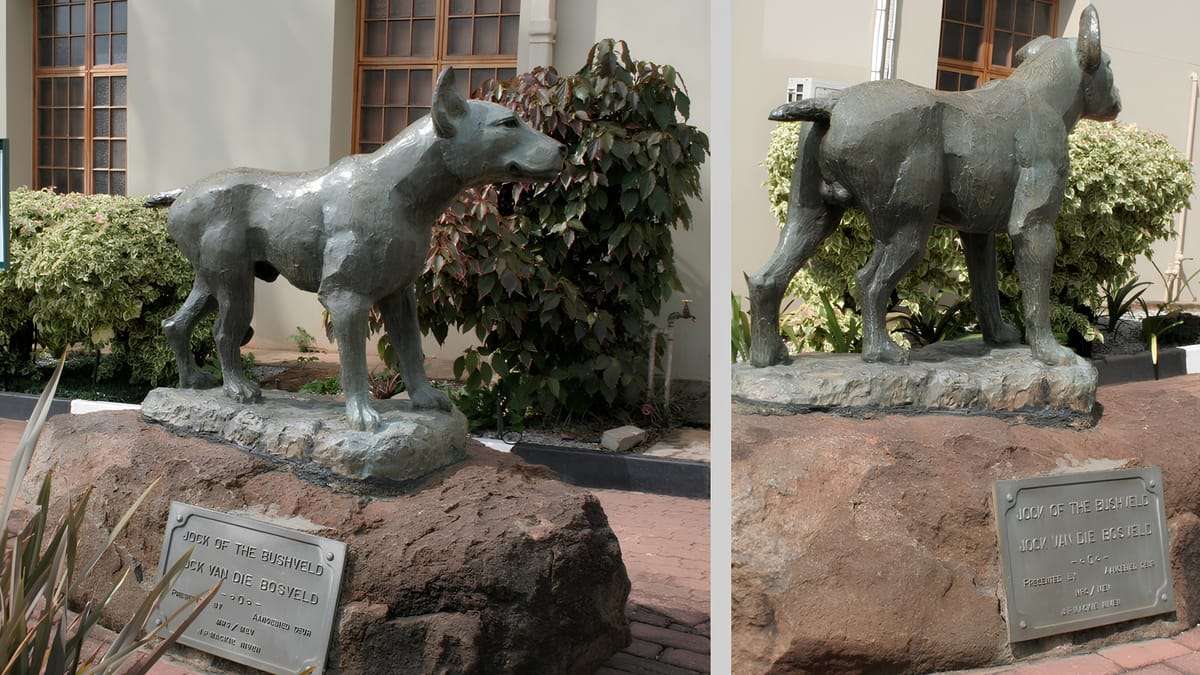

Few stories are as deeply woven into the fabric of Lowveld history as Jock of the Bushveld. For more than a century, readers have followed the adventures of Percy FitzPatrick and his loyal Staffordshire terrier, Jock, through the wild landscapes of the eastern Transvaal. The book has become a South African classic, celebrated for its tales of courage, friendship and survival in a frontier wilderness, yet for many readers, one question lingers long after the final page has been turned. Did it all really happen?
The answer, like many historical mysteries, is both simple and complicated. The evidence suggests that Jock of the Bushveld is neither pure fact nor complete fiction. Instead, it occupies that fascinating space where history, memory and storytelling meet. Percy FitzPatrick was no fictional character. Born in England in 1862, he arrived in southern Africa as a young man during a period of extraordinary change. Drawn by the opportunities created by the discovery of gold in the eastern Transvaal, he eventually found his way to the De Kaap Valley and the bustling goldfields around Barberton.
Like many young fortune seekers of the era, FitzPatrick tried his hand at various occupations. He prospected, worked in business and spent time as a transport rider, travelling the rugged wagon routes that linked the goldfields to Delagoa Bay, now Maputo.
These experiences exposed him to a world that few modern South Africans can easily imagine. The Lowveld of the 1880s was a frontier landscape where transport riders crossed swollen rivers, navigated dangerous mountain passes and shared the bush with lions, leopards, buffalo and countless other wild animals.
There is little doubt that FitzPatrick experienced genuine adventure during these years. The question is not whether exciting things happened to him. The question is how closely the events described in Jock of the Bushveld reflect those original experiences. Among historians and literary scholars, there is broad agreement on one point: Jock himself almost certainly existed. Contemporary accounts, family recollections and FitzPatrick's own writings all support the existence of a dog named Jock that accompanied him during at least some of his travels through the Lowveld.


The dog appears to have made a lasting impression on those who knew him. Long before the book was written, stories about Jock were already circulating among FitzPatrick's friends and acquaintances. What remains more difficult to verify are the extraordinary adventures attributed to him. Readers of Jock of the Bushveld encounter a dog of almost legendary courage and intelligence.
Jock confronts dangerous animals, survives incredible situations and repeatedly demonstrates loyalty that borders on the heroic. Some episodes seem so extraordinary that modern readers often wonder whether they could possibly be true. The answer may lie in understanding how stories were told in the late nineteenth century.
Before FitzPatrick became an author, he was a storyteller. Like many transport riders, hunters and prospectors of his era, he spent countless evenings around campfires sharing tales of the road. Such stories were part entertainment, part history and part social tradition.
Anyone familiar with campfire storytelling knows that stories have a tendency to evolve. Details become sharper. Characters become larger than life. Adventures become more dramatic with each retelling. This does not mean the stories are false. Rather, they become polished over time, shaped into narratives that capture the imagination. Another important factor is the passage of time. The events described in Jock of the Bushveld occurred during FitzPatrick's youth in the 1880s. The book itself was not published until 1907, more than twenty years later.
By then, FitzPatrick had become a successful businessman and public figure. The stories had been told and retold countless times, first to friends and later to his children. According to popular accounts, it was his children who encouraged him to write them down, while author Rudyard Kipling is often credited with persuading him that the stories deserved publication.
 Lynette Spencer
Memory is a curious thing. Historians recognise that even honest eyewitnesses rarely remember events exactly as they occurred decades earlier. Memories blend together. Details fade. Some incidents become more vivid while others disappear entirely. What emerges is often not a precise record of events but a story that captures the essence of an experience. Perhaps the strongest evidence in favour of the book's authenticity lies not in the individual adventures but in its setting.
The transport riders, prospectors, traders and hunters who populate the pages were inspired by people he genuinely knew. The landscapes are recognisably those of the Lowveld and De Kaap Valley. The challenges of travel, disease, isolation and frontier life reflect the realities of the gold rush era.
Even if certain episodes were embellished or combined for dramatic effect, the broader picture remains historically accurate. Readers may not be encountering a literal diary of events, but they are experiencing a vivid portrayal of a vanished world. More than a century after its publication, Jock of the Bushveld continues to resonate with readers because it offers something greater than historical precision. It captures the spirit of a remarkable time in South African history. The book evokes an era when the De Kaap Valley stood on the edge of a gold rush, when wagon roads crossed untamed landscapes and when adventure seemed to wait around every bend in the track.
Whether every lion encounter occurred exactly as described or every act of canine heroism happened precisely as remembered ultimately misses the point. The story survives because it speaks to universal themes: friendship, loyalty, courage and perseverance.
Perhaps the best way to understand Jock of the Bushveld is to see it not as a historical document and not as a novel, but as something in between.
The foundations are real. Percy FitzPatrick was real. Jock was real. The wagon roads, the goldfields and the frontier world of the Lowveld were real. Around those foundations, however, memory, imagination and storytelling worked together to create something larger than life. In doing so, FitzPatrick achieved something few authors ever manage. He transformed the experiences of one transport rider and one faithful dog into a legend that became part of South Africa's cultural heritage.
More than a hundred years later, readers are still asking whether it all really happened. Perhaps that enduring question is itself the clearest sign that a legend was born.
 Naomi Roebert
 Mariana Balt
 Anchen Coetzee
 Liz Thorne
Comments ()